
Cold Rooms in Kenya: Chillers, Freezers and Blast Freezers
A practical guide to specifying cold storage — the right temperature for your product, how rooms are actually sized, what they cost, and when solar makes sense. Written by the engineers who install them.
Kenya loses about a third of its perishables after harvest
Research published by WRI Africa in 2025 put the cost of food loss and waste in Kenya at roughly KES 72 billion a year, with 30–40% of production never reaching a consumer. For crops that depend on cooling, the losses are concentrated in the first mile — between the farm and the first controlled storage.
The clearest illustration is avocado. Roughly 35% is lost in the domestic market against about 15% in the export chain. The fruit is the same. What differs is that the export pathway has cooling, grading and handling discipline behind it, and the domestic one largely does not.
Estimated annual cost of food loss and waste in Kenya
WRI Africa, 2025Range of mango losses, depending on post-harvest handling
WRI Africa, 2025Avocado losses, domestic market against export channel
WRI Africa, 2025A cold room is not an overhead. For most horticulture and dairy operations it is the single intervention that changes how much of what you produce actually gets sold at full value.
Find the right temperature for your product
The most common and most expensive specification error is treating “chiller” as a single setting. It isn’t. Every crop has an optimum temperature and humidity, and several of Kenya’s most valuable exports are damaged by storage that would be perfectly correct for something else.
These are the widely accepted storage conditions for products commonly handled in Kenya.
| Product | Temperature | Relative humidity | Notes |
|---|---|---|---|
| Leafy greens, herbs | 0 to 2°C | 90–95% | High air speed causes bruising; needs baffled airflow |
| Cut flowers | 1 to 3°C | 90–95% | Ethylene-sensitive; store away from ripening fruit |
| French beans | 5 to 7.5°C | 95–100% | 8–12 days; chilling injury develops below 5°C |
| Avocado | 5 to 7°C | 85–90% | Below ~4°C causes mesocarp darkening and off-flavours |
| Mango | 10 to 13°C | 85–90% | 2–3 weeks. Never below 10°C — see the warning below |
| Banana, papaya | 10 to 13°C | 85–95% | Chilling injury below ~10°C |
| Tomatoes | 10 to 13°C | 85–90% | Chilling-sensitive; loses flavour if over-cooled |
| Oranges, mandarins | 4 to 7°C | 85–90% | — |
| Lemons, limes | 10 to 13°C | 85–90% | Below 10°C causes pitting; store apart from other citrus |
| Onions, garlic | 0°C | 65–70% | The exception to high humidity — damp causes sprouting and neck rot |
| Potatoes | 2 to 10°C | 50–70% | Depends on variety and whether for table or processing |
| Milk and dairy | 2 to 4°C | — | The standard chilled band |
| Fresh red meat | −1 to +1°C | 85–90% | Superchill reduces drip loss and slows microbial growth |
| Poultry | 0 to 2°C | High | Good drainage essential to avoid ice pooling |
| Fresh fish | −1 to 0°C | High | Held on ice; the most temperature-critical product on this list |
| Frozen storage | −18°C or below | — | The international reference for long-term frozen goods |
| Deep frozen | −30°C or below | — | Premium storage for delicate product and long-hold protein |
The mango mistake
Mangoes are chilling-sensitive. Stored below about 10°C they develop skin pitting, lenticel discolouration that spreads into dark patches, and they lose the ability to ripen normally — damage that often only becomes visible after the fruit has left your premises. Yet a standard chiller supplied without asking what goes in it will typically be set around 4°C, which is correct for dairy and wrong for mango.
If a supplier quotes you a cold room without asking what you’re storing, they are guessing. Ask them what temperature they intend to set it to, and why.
One further point that catches people out: as a rule, don’t mix crops in a single room. Different products want different temperatures and humidities, some emit ethylene that ripens others prematurely, and odours transfer. Short periods are usually tolerable; weeks are not. If you handle several incompatible products, you need either separate rooms or separate zones, and that decision belongs at the design stage rather than after the room is built.
Chillers
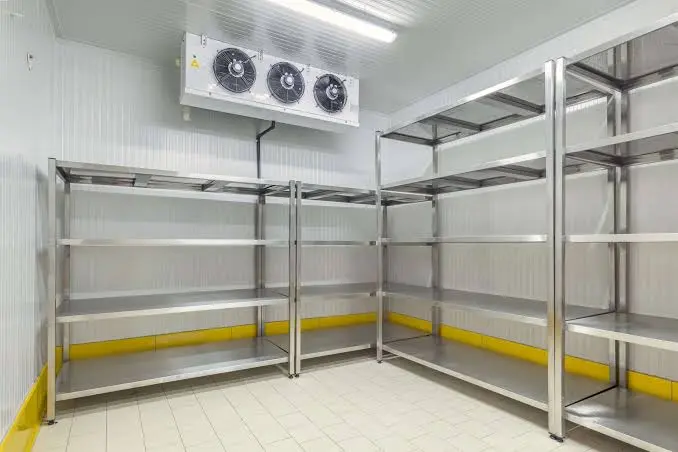
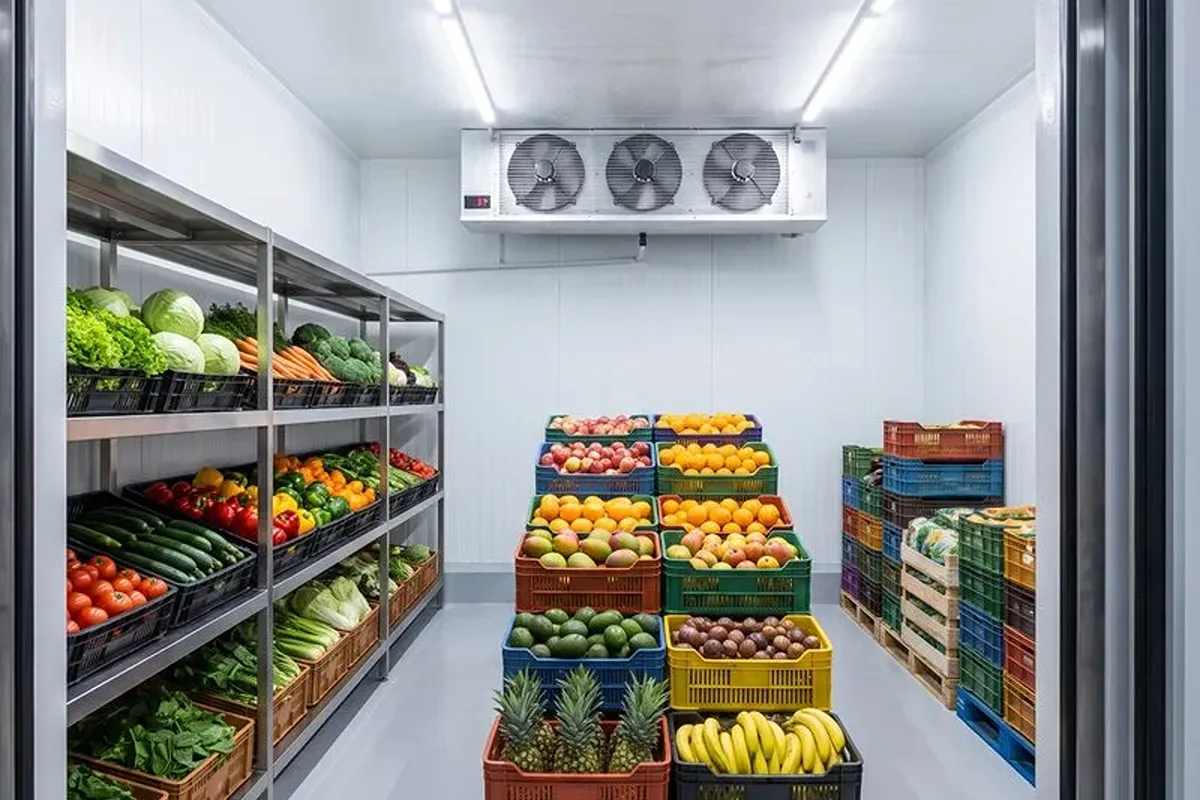
Typically 0°C to +13°C, set to the productA chiller holds produce above freezing. It slows respiration, ripening, water loss and microbial growth without changing the product, which is why anything sold fresh goes into a chiller. Most cold rooms in Kenya are chillers, and most of what we install falls into this category.
The important thing about a chiller is that its set point is a decision, not a default. Leafy vegetables want 0–2°C. Dairy wants 2–4°C. Mango wants 12°C. A room built without that conversation will be set to whatever the installer usually sets, and for some products that is actively harmful.
Humidity matters nearly as much as temperature. Produce held in air that is too dry wilts and loses saleable weight. Achieving high humidity means specifying a larger evaporator coil running at a smaller temperature difference — a design choice made when the room is quoted, not something you can adjust afterwards.
- Best forFresh horticulture, dairy, cut flowers, meat awaiting processing, hotel and restaurant kitchens, supermarket back-of-house, pharmacy stock
- Panel thicknessCommonly 75–100mm depending on set point and sun exposure
- Watch forChilling-sensitive crops, humidity control, mixing incompatible products
Freezers
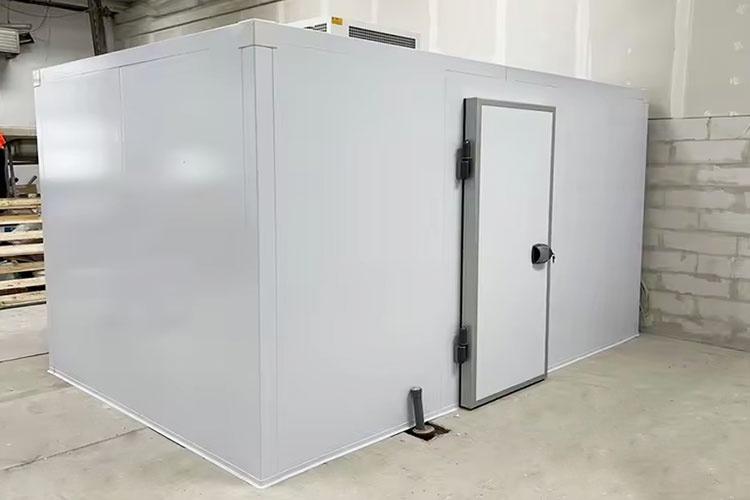
−18°C to −25°CA freezer stops biological activity rather than slowing it, which buys you months instead of days. It costs more to build and more to run, and the reasons are worth understanding because they explain the price gap.
A freezer in Nairobi holds a temperature gap of roughly 45°C against ambient, where a dairy chiller holds about 22°C. Double the gap means double the heat flowing in through every square metre of wall, so the panels get thicker and the refrigeration plant gets larger. Freezers also need defrost cycles, and defrost adds heat back into the room — typically costing several percent of effective capacity depending on the method used.
The floor matters more than people expect. A freezer sitting on an uninsulated slab will slowly freeze the ground beneath it, and frost heave can lift and crack the floor over time. Insulated flooring, or under-floor heating in larger installations, is part of a properly specified freezer rather than an upsell.
- Best forMeat, fish, ice cream, processed foods, frozen vegetables, long-hold stock
- Panel thicknessCommonly 100–150mm; deep-freeze applications go higher
- Watch forFloor insulation, defrost strategy, door heaters to prevent icing
Blast freezers
−30°C to −40°CA blast freezer is different in kind, not merely in degree. A standard freezer holds product that is already frozen. A blast freezer pulls product down fast — from ambient to frozen in hours rather than days — after which the product moves to a holding freezer.
Speed changes what happens inside the food. Slow freezing grows large ice crystals that rupture cell walls, so on thawing the product leaks moisture, loses texture and loses saleable weight. Fast freezing forms small crystals and leaves cell structure largely intact. If you sell frozen product to anyone who judges it after thawing — an exporter, a processor, a supermarket — that difference is the whole business.
Blast freezing is also the most demanding thing you can ask of a refrigeration system. Rapid pull-down can require a compressor several times larger than a daily-average calculation would suggest, because the entire heat load has to be removed in a few hours rather than spread across a day. A blast freezer specified from volume alone will not perform.
- Best forFish and meat processors, export horticulture, prepared foods, bakery
- Key specBatch size and required pull-down time, not room volume
- Watch forPeak electrical demand, airflow design, product spacing on racks
Blast freezing is specified differently from ordinary frozen storage. Talk to us early if you’re evaluating one.
How a cold room is actually sized
Cold rooms are not sized by volume. They are sized by heat load — the total amount of heat the refrigeration plant has to remove every day to hold your temperature. Two rooms of identical size can need very different equipment depending on what goes in them and how often the door opens.
Heat load comes from four independent sources, each calculated separately and then added together.
Transmission
Heat conducted through walls, roof and floor. Driven by panel U-value, surface area and the temperature gap against ambient. This is where insulation thickness earns its money, and where a wall in direct Kenyan sun needs more than a shaded one.
Infiltration
Warm, humid air entering every time the door opens. A well-sealed store might see a handful of air changes a day; a busy processing room with constant traffic can more than double that. In freezers with heavy traffic, infiltration can exceed transmission entirely.
Product pull-down
The heat carried in by warm product, plus — for anything being frozen — the latent heat of turning water to ice. That latent component is often the single largest load in a freezer, and it is the one most often left out of quick estimates.
Internal gains
Lighting, evaporator fan motors, forklifts, people working inside, and defrost heaters. Individually small, collectively often around a tenth of the total.
A safety margin of roughly 10–15% is then added to the sum, covering model uncertainty, component ageing and real-world variation. Undersize the plant and the room never reaches temperature on hot days. Oversize it and the compressor short-cycles, which wastes energy and shortens its life. Neither is fixable after installation without replacing equipment, which is why the calculation matters more than the quote.
What panel thickness actually means
Insulated panels are sold by thickness, but what matters is U-value — the rate at which heat passes through, in watts per square metre per degree. Lower is better. Panels in common use fall roughly between 0.20 and 0.35 W/m²·K, and for freezer applications a target below about 0.24 is a reasonable benchmark.
Two practical points that quotes rarely mention. Panels facing direct sun should generally step up one thickness grade, because published U-values assume shade and Kenyan sun on a west-facing wall is a real load. And U-values assume new, dry insulation with an intact vapour barrier — moisture getting into panel joints over the years can degrade real-world performance substantially, which is why joint sealing and vapour barriers are worth paying attention to at installation.
What we’ll ask before we quote
Two quotes for what looks like the same room can differ widely, and it is almost always because they were built on different assumptions about how the room will be used. We would rather ask than assume, so the assessment comes before the number.
These are the questions we work through with you. Having the answers ready makes the process quicker and the quotation more accurate.
- Your actual operating temperature. Not just “chiller” or “freezer” — 12°C for mango, 2°C for dairy. This single answer prevents the most expensive mistake on this page.
- What you’re storing, and how much arrives per day. Daily intake drives the pull-down load, which often matters more than total capacity.
- The temperature your product arrives at. Field-warm produce at 28°C is a completely different load from product already cooled elsewhere.
- How often the door will open. A store opened twice a day and a processing room in constant use need different equipment at the same volume.
- A drawing, if you have one. Door positions, columns, ceiling height, drainage and where the evaporator can physically sit all shape the design in ways a volume figure cannot show.
- Where the room will sit — indoors, outdoors, under a roof, against a sun-exposed wall — and the maximum ambient temperature at your location.
- Whether you need rapid freezing or frozen holding. Treating a blast freezing requirement as ordinary frozen storage guarantees an undersized system.
- Your power situation: reliable grid, unreliable grid, or no grid at all.
If any of this is unclear, that is what the site visit is for. Tell us what you’re trying to keep cold and we will work the rest out with you.
Cold room prices in Kenya
Price is driven mostly by capacity and by whether you need a chiller or a freezer. These are the ranges we typically quote, supplied and installed, for grid-powered rooms.
| Size | Chiller | Freezer |
|---|---|---|
| Small — 10–20m³ | KES 400,000 – 800,000 | KES 500,000 – 1,000,000 |
| Medium — 20–50m³ | KES 800,000 – 2,000,000 | KES 1,000,000 – 2,600,000 |
| Large — 50–100m³ | KES 2,000,000 – 3,500,000 | KES 2,500,000 – 4,600,000 |
| Extra large — 100m³+ | From KES 3,500,000 | From KES 4,400,000 |
The refrigeration plant alone is typically 40–50% of the total. European compressors cost more than Chinese equivalents but run more efficiently, which compounds on a load that never switches off — we quote both and explain the difference. Installations outside Nairobi carry transport and accommodation costs, quoted per project rather than as a flat percentage.
Included: insulated panels and room assembly, refrigeration plant, door and hardware, installation, commissioning and temperature verification, plus a two-year warranty on the panels and one year on the refrigeration machinery.
Not included: concrete slab or floor preparation, and electrical supply brought to the point of connection.
We publish this split because the gap between competing quotes is usually here, not in the headline number.
Powering it: grid, solar, or both
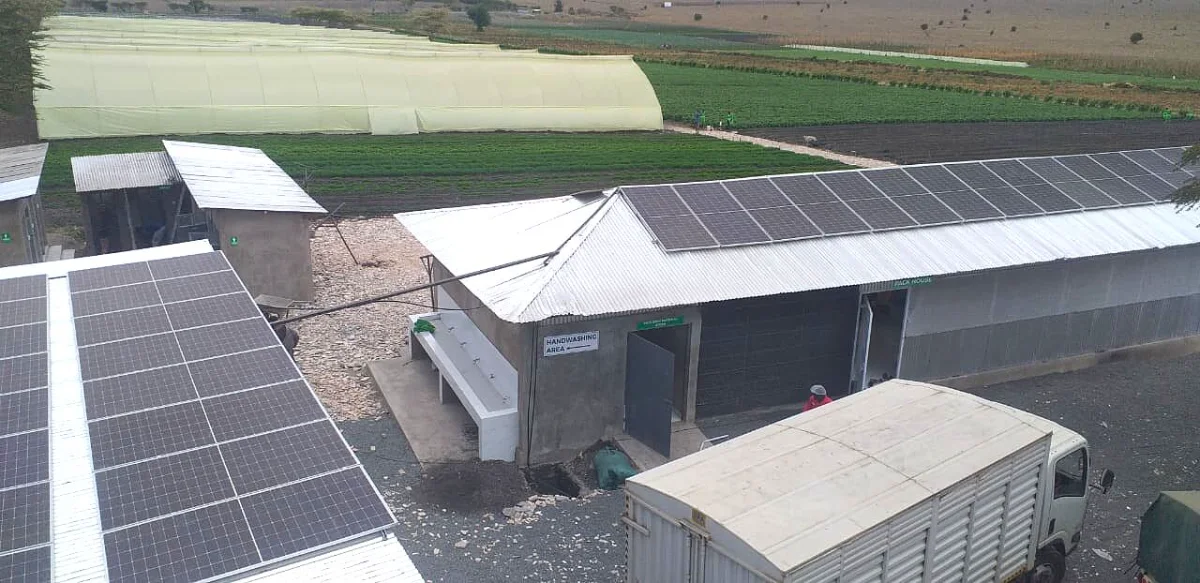
A cold room runs day and night, every day of the year. That continuous load makes the power decision an operating-cost decision as much as an installation one, and it is the question most refrigeration suppliers are least equipped to answer.
Solar is the only answer
Diesel can run a cold room, but fuel and servicing on a 24-hour load overtake the cost of an array quickly, and a generator failure at 2am means losing everything inside. Off-grid needs solar sized to the load plus battery to carry the night. That battery is where most of the cost sits, and it is what cheap off-grid quotes leave out.
An economic decision
Grid is cheaper to install — no array, no battery, running sooner. Over the life of the room solar usually wins, because a cold room’s steady, predictable load is close to the best case for solar economics. Whether it wins for you depends on your tariff and run hours, so we would rather model it against your actual bill than quote a generic payback.
Hybrid
This describes most of Kenya. Grid as the primary supply, with solar and battery carrying you through outages. You avoid the full cost of an off-grid system while removing the risk that one long blackout costs you a room full of stock.
Why we quote solar separately
A cold room’s solar requirement follows from the room’s heat load, not from a formula applied to its size. Four things drive it:
Temperature and room size
A freezer holds roughly double the temperature gap of a chiller, so it draws considerably more and needs a larger array and battery.
Door traffic
Every opening admits warm, humid air the plant then has to remove. A processing room in constant use can draw far more than a store opened twice a day.
Overnight autonomy
The room runs all night on battery. How many hours of backup you specify is the single biggest cost lever in an off-grid system.
Off-grid or hybrid
Off-grid must carry the entire load alone. Hybrid only covers outages, which is considerably cheaper for the same room.
Blast freezing deserves a caveat. It draws a large, spiky load — high peak demand for a few hours during pull-down rather than the steady cycling of a chiller. That is a poor fit for solar without substantial battery or hybrid support, and we will say so rather than sell you an array that cannot do the job.
Because we are a licensed solar EPC as well as a cold room supplier, we size the array against the actual room we are building for you. Most refrigeration companies subcontract that work. We do not.
About two weeks, order to running room
We hold cold room panels in stock in Nairobi and cut them to your dimensions. You are not waiting on a shipment from overseas, and you are not forced into a catalogue size.
Assessment and quote
Tell us your product, daily volumes, site and power situation. We calculate the heat load, specify the plant, and quote — including an honest view on whether solar is worth it for you.
Materials on site
Panels are cut to your dimensions from stock and delivered within about a week of order confirmation.
Construction and handover
Around seven days on site to assemble the room, install and commission the refrigeration plant, verify it holds temperature, and hand over.
What we need from you before the clock starts: a level, prepared floor slab and an electrical supply brought to the point of connection. Sites that are not ready are the usual reason a project slips. If a room has failed or produce is arriving with nowhere to go, say so at first contact — turnaround is usually where we can help most.
Common questions
How much does a cold room cost in Kenya?
What temperature should a cold room be set to?
Why can’t I store mangoes in a normal chiller?
Can I store different crops in the same cold room?
How is a cold room sized?
What’s the difference between a freezer and a blast freezer?
Can a cold room run entirely on solar?
How long does it take to install a cold room?
What panel thickness do I need?
Do you work outside Nairobi?
What warranty do you offer?
Tell us what you’re storing
Send us your product, your daily volumes and your site location. We’ll calculate the heat load, recommend the right room and temperature, and give you an honest view on whether solar is worth it for you.