

As Africa’s solar imports skyrocket 60% to a record 15 GW as of June 2025, Kenya is at the forefront of this green revolution.
The continent is witnessing an unprecedented shift toward renewable energy, driven by plummeting costs, policy commitments, and the urgent need to address energy poverty affecting over 600 million people. In this broader context, solar panel imports from China alone reached 15,032 MW, marking a transformative moment as nations pivot from fossil fuels to sustainable power sources.
In 2025, Kenya emerged as Africa’s solar powerhouse, driving the green energy revolution through innovative policies, off-grid innovations, and mega-projects that not only boost capacity but also electrify remote communities, create jobs, and position the continent as a renewable leader.
In this article, we explore the continental surge of solar power, Kenya’s leadership through companies like Plasma Solar that are leading the charge, challenges, and future horizons, providing insights into how this East African nation is illuminating the path forward.
The Continental Solar Surge: Africa’s 2025 Wake-Up Call
Africa’s solar photovoltaic (PV) market is exploding in 2025, with annual installations projected to grow by 42%, adding over 3.4 GW of capacity and setting the stage for an additional 23 GW by 2028—more than doubling the current installed base from 2024’s 2.4 GW. At the heart of this boom is a 60% surge in solar panel imports from China, totaling 15 GW, with 20 countries shattering previous records.
Excluding South Africa, imports have tripled from 3.7 GW to 11.2 GW in just two years, reflecting widespread adoption across sub-Saharan Africa. Standout performers include Algeria with a staggering 33-fold growth, Zambia at 8 times previous levels, and Botswana at 7 times, alongside notable increases in Ethiopia, Angola, and the Democratic Republic of Congo. In countries like Liberia and Benin, solar is poised to replace diesel generators, potentially boosting electricity shares by 5-10%.
This surge isn’t happening in a vacuum. Global and local catalysts are fueling the momentum. Solar panel costs have fallen dramatically, often achieving payback periods shorter than diesel alternatives amid rising oil imports and frequent power outages.
Policy momentum has accelerated post-COP commitments, with events like the Africa Climate Summit galvanizing action and leading to import highs in 20 nations. Investment trends are shifting too: while Africa captures only 3% of global energy finance, solar’s potential in green hydrogen production and electric mobility is drawing private capital, though bottlenecks remain.
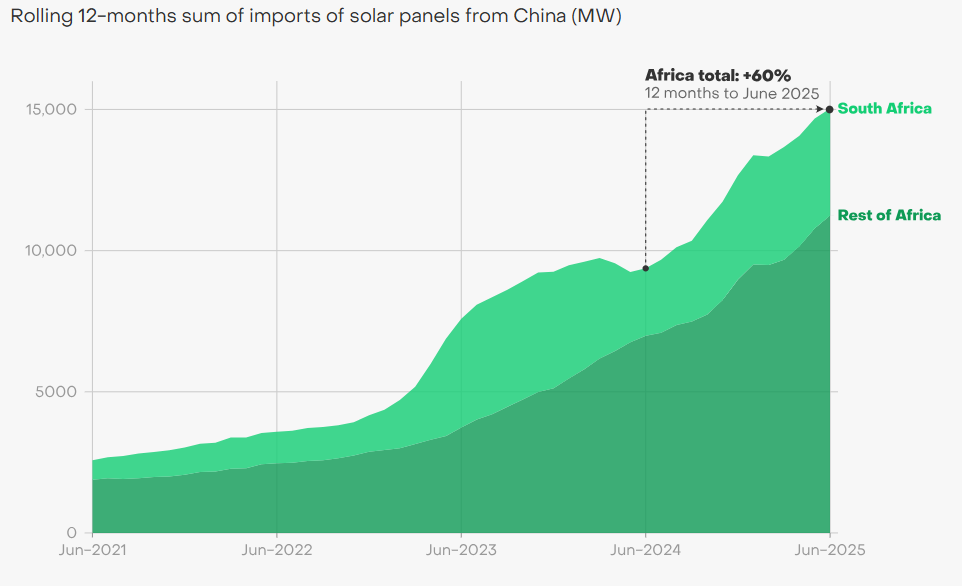
[Source: Ember Energy]
Kenya’s Pioneering Role: From Policy to Power Plants
Kenya’s leadership in this revolution stems from robust policy foundations aimed at achieving 100% renewables. The National Energy Compact 2025-2030 targets 5,952 MW of renewable capacity by 2030, including significant solar scaling alongside geothermal (1,681 MW), hydro (1,403 MW), and wind (966 MW), all contributing to universal energy access by the decade’s end.
Key initiatives include the Draft Renewable Energy Regulations 2025, which establish frameworks for investment, green skills programs to build a skilled workforce, and incentives to attract private players.
Flagship projects are turning these policies into reality.
On the grid-scale front, an 80 MW tender for two 40 MW solar farms in Isinya and Makueni was launched in March 2025, while the 42.5 MW solar plant with 3 MW/4.5 MWh battery storage at Seven Forks enhances grid stability.
Upcoming developments like the 40 MW Kisumu Solar Power Station and the 70 MW Bavinci Africa project in Nairobi, set to come online this year, underscore Kenya’s ambition. Off-grid innovations are equally vital: the Kenya Off-Grid Solar Access Project (KOSAP) is electrifying remote areas through mini-grids, with community-based solar systems expanding rapidly to meet the 100% access goal by 2030.
Innovation extends to local manufacturing, with emerging solar panel production in Special Economic Zones (SEZs) and trends like hybrid solar-storage systems and rural mini-grids defining the 2025 landscape. Compared to peers, while South Africa and Egypt boast larger GW-scale installations, Kenya excels in per-capita innovation and off-grid penetration, solidifying its status among Africa’s top green energy leaders.
Transformative Impacts: Powering People, Economies, and the Planet
The solar surge is delivering profound social gains by bridging Africa’s energy divide. In Kenya, mini-grids and off-grid solutions are targeting last-mile electrification, reducing dependence on kerosene and diesel while potentially increasing national energy shares by 5-10% through scaling. This shift improves health by cutting indoor air pollution and enhances education by powering schools and clinics in underserved rural areas.
Economically, the boom is a game-changer. It promises thousands of jobs in installation, manufacturing, and maintenance, fostering green industrialization and positioning Kenya as a regional hub. Cost savings from reduced oil imports and solar’s rapid return on investment are driving industrial growth, with events like Powerelec Kenya 2025 highlighting lucrative opportunities. Environmentally, decentralized solar is slashing emissions and preserving biodiversity, aligning with global net-zero ambitions.
Hurdles on the Horizon: Challenges and Strategic Solutions
Despite the progress, significant barriers persist.
Financing gaps are acute, with projects costing 3-7 times more than in developed markets; Africa requires $200 billion annually but receives less than 3% of global energy funds. A green skills shortage threatens the 100% renewables target by 2030, with installation capacity lagging behind imports. Infrastructure issues, such as grid integration, reshipping risks, and regulatory delays, further complicate rollout.
Solutions are emerging through innovative finance like de-risking tools, public-private partnerships, and blended funding models exemplified by companies like Plasma Solar who offer farmers, home owners and industrialists PPA agreements that require minimal upfront investment.
Capacity building via training programs and local manufacturing aims to close skills gaps. Technological integrations, including hybrid solar-storage and AI-optimized grids, promise greater reliability.
Looking Ahead: Kenya’s Vision for a Solar-Powered Africa
In 2025, milestones like a 42% market surge could fuel over 100 MW in new Kenyan additions, while continent-wide growth to 23 GW by 2028 unlocks opportunities in hydrogen exports and e-mobility. Globally, Kenya serves as a model for equitable green transitions, inspiring neighbors like Ethiopia and Tanzania. Investors, policymakers, and communities must seize this “solar boom” to build a sustainable future.
Conclusion: Igniting the Revolution
Kenya’s lead in Africa’s 60% solar import surge and 42% growth trajectory is transforming energy access, economies, and the environment. Kenya isn’t just harnessing the sun—it’s powering Africa’s future. Join the revolution. Check out what Plasma Solar has been doing in the region and how you can gain access to innovative solar solutions built to fit your specific needs.
